
AXION AUTOMOTIVE · DIDCOT & UK POSTAL ENQUIRIES
ECU testing and component-level repair
Engine control unit testing, component-level repair and supported cloning for car owners and garages. Visit our Didcot workshop by appointment or arrange a UK postal assessment for a suitable removed ECU.
UK-wide ECU diagnostics, component-level repair and donor cloning. AXION Automotive helps garages, auto electricians and vehicle owners resolve ECU faults without automatically replacing the unit. Contact us before removing or sending a unit. We can discuss a workshop assessment in Didcot, Oxfordshire, or the postal route for a suitable removed ECU.
Find what you need · Bench testing · Circuit-board repairs · Cloning and programming · Costs and booking
ECU repair and cloning services
We assess the ECU before recommending repair or replacement. If the electronic fault can be repaired, we explain the work and test the unit afterwards. If a donor is needed, its compatibility and the condition of the original data determine whether a transfer is possible.
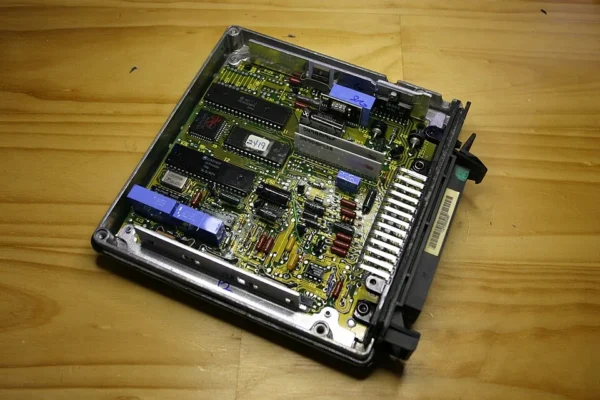
- Component-level ECU repair – power-supply faults, injector or ignition drivers, CAN communication faults, water damage and damaged tracks.
- ECU cloning – compatible flash, EEPROM and calibration data transfer to a donor unit, subject to a successful assessment.
- Data recovery – controlled extraction from damaged or non-communicating modules where technically possible.
- Workshop support – clear reporting and practical next steps for independent garages and auto electricians.
Common ECU symptoms we investigate
- Engine cranks but does not start
- No communication with the engine ECU
- Persistent injector, ignition, throttle or actuator fault codes
- Missing 5V reference supply or multiple unrelated sensor faults
- Water ingress, corrosion or visible heat damage
- Immobiliser synchronisation or donor-unit compatibility issues
Symptoms alone do not prove the ECU is faulty. Describe what happens when you try to start or drive the car, when the problem began and any checks already completed. Add your registration and any fault codes or part number you have. You can still enquire without a diagnostic report.
What an ECU bench test can establish
A bench assessment separates the removed controller from the vehicle wiring. Depending on the unit and reported fault, checks can cover its internal power supplies, communication interface, sensor-reference circuits and supported output stages. A fault that only appears with heat, vibration or a particular load needs that condition described in the enquiry.
A communicating ECU is not automatically a healthy ECU. Equally, a fault code naming a controller does not prove its circuit board has failed. A shorted sensor, actuator or wiring branch can pull down a supply or damage an output. The vehicle-side cause must be checked before a repaired or replacement unit is refitted.
Component-level repairs to the original ECU
A repair starts with the failed circuit and its cause. Depending on the controller, the work may involve a power-supply stage, communication component, injector or ignition driver, connector connection or damaged circuit-board track. We assess the surrounding damage before deciding whether the original unit can be repaired reliably.
Tell us if a sensor, actuator or wiring fault has already damaged the ECU. That external fault needs attention too. Before the unit goes back into the vehicle, agree which checks have been completed on the bench and which installation, coding or vehicle checks remain with the garage. Keep the diagnostic report with the repair record.
A recent Mercedes-AMG ECU repair
On 18 October 2026, we repaired a Mercedes-AMG G-Class ECU whose injector-driver output stayed high instead of pulsing and switching off. We traced the fault to the clock line to the MCU inside the ECU. The fault location in this job shows why the output symptom needs circuit-level investigation.
Read the Mercedes-AMG repair notes and other recent workshop jobs.
Repair, cloning or programming
Repair addresses a fault in the original electronics where viable. Cloning transfers supported data to compatible replacement hardware. Programming and coding prepare a supported unit for its vehicle. These are different jobs, and replacing the casing or matching one number is not enough to choose between them.
Send a clear photograph of the complete label, the make, model, year and engine, and the original scan report. Keep the original ECU even if it does not communicate. For damaged memory or a failed previous write, see ECU flash and EEPROM data recovery. For replacement-module setup, see vehicle module programming and coding.
ECU testing and repair costs
The assessment charge, repair scope and any postage are confirmed before booking. A bench test, circuit-board repair and donor-data transfer involve different work, so a fault code alone cannot produce a reliable fixed repair price. Ask for the assessment cost and what happens if the unit proves unrepairable before sending it. You can review assessment services and appointments or contact us with the unit details.
How the repair process works
- Request a quote. Send vehicle details, fault codes and ECU part number through our contact form or WhatsApp.
- Send or drop off the module. Once the job is agreed, pack the ECU securely and use an insured, tracked delivery service.
- Bench diagnosis. We inspect the unit, test power and communication circuits, and confirm the appropriate repair or cloning route.
- Approval before work. We explain the recommended work and price before proceeding.
- Repair, verification and return. Completed units are checked before return by tracked delivery or collection.
Before buying a replacement ECU
Send us the original and proposed donor part numbers first. A similar-looking casing does not confirm compatibility. We need to establish whether the original data is recoverable and whether repair, cloning or vehicle-specific programming is the appropriate route. Keep the original unit and tell us about previous programming attempts.
Working on a customer vehicle? Our garage and trade support page explains what to include with a technical enquiry. For a job that needs the complete vehicle, ask about a Didcot appointment before arranging transport.
Need a different controller assessed? Use our TCU and gearbox control unit testing or BCM and BSI repair service. The vehicle module finder can help you prepare the vehicle and module details for an enquiry.
Frequently asked questions
Can you repair an ECU with no communication?
Some units can be accessed directly on the bench even when vehicle diagnostics cannot communicate. The outcome depends on the damage and the module type.
How long does ECU repair take?
Turnaround depends on the fault, parts availability and testing requirements. We confirm the expected timescale after diagnosis.
What if the ECU cannot be repaired?
We explain the findings and available options. No repair work proceeds without your approval.
Get an ECU repair assessment
Include your vehicle registration, ECU part number, fault codes and a brief description of the symptoms. Our workshop is at Unit 2, Long Wittenham Road, Didcot, Oxfordshire, OX11 9BH.
Get in touch
Identify the job
Send your vehicle details, part number, symptoms and any diagnostic report. Include previous work and donor details where relevant.
Postal or workshop?
Contact us before sending a module or travelling to Didcot. We will discuss which route is suitable for your job.
Nationwide support
Based in Didcot, Oxfordshire, with postal module enquiries from garages and owners across the UK.
Engine fault-code guides
Read related fault and diagnostic guides
P0300 and P0301–P0304 after replacing spark plugs or coils
Crankshaft and camshaft signal faults P0335 and P0340
Checking MAF air-mass sensor faults P0100 and P0101
Distinguishing coolant signal faults P0115 and P0118 from overheating
Electrical diagnosis of EGR flow codes P0400, P0401 and P0402
Checking DPF pressure sensors, hoses and readings
P2138 accelerator pedal correlation faults and reduced power
Oxygen sensor signal and heater faults P0130 and P0135
P0201–P0204 injector circuit faults after replacement
Boost pressure faults P0299 and P0234 and turbo actuator checks